Publication Ethics
Publication Ethics
Publication Ethics and Malpractice Statement
Publication Ethics and Malpractice Statement
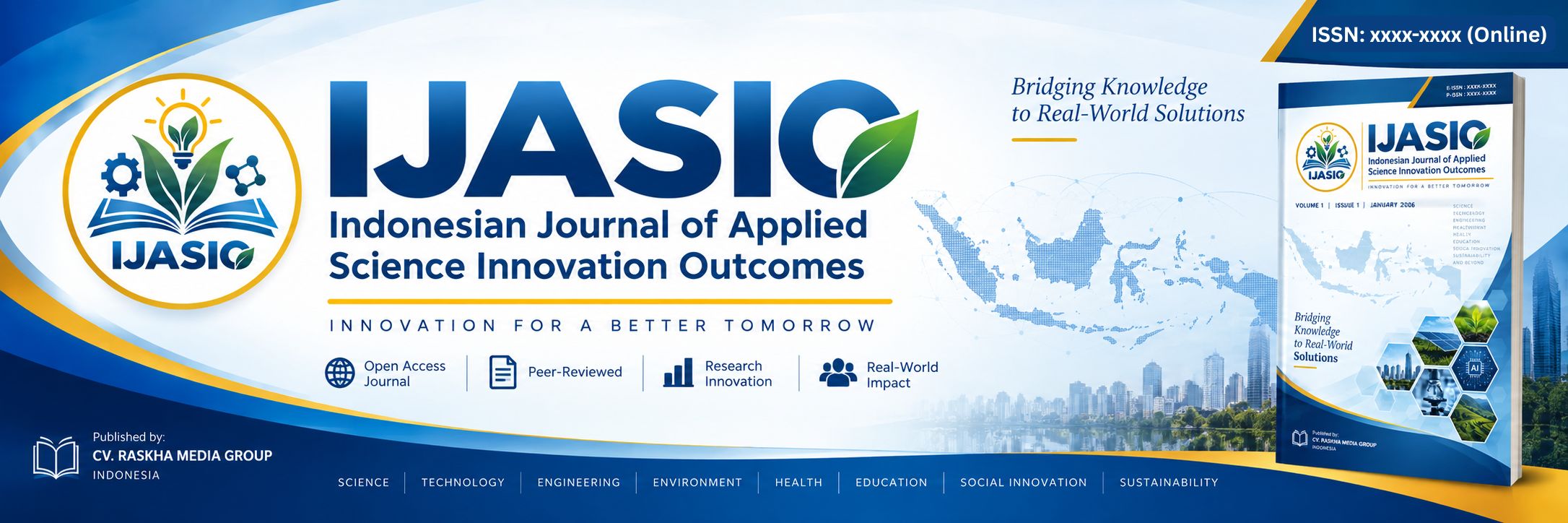
This Publication Ethics and Malpractice Statement describes the ethical responsibilities of authors, reviewers, editors, and the publisher of the Indonesian Journal of Applied Science Innovation Outcomes (IJASIO).
IJASIO is committed to maintaining high standards of publication integrity, transparency, accountability, and responsible scholarly communication. The journal follows recognized principles of publication ethics, including the core principles promoted by the Committee on Publication Ethics (COPE).
Core Principles
Research and publication activities should be conducted honestly, responsibly, and transparently.
Editorial and publication processes should be transparent and appropriately documented.
All participants in the publication process are responsible for fulfilling their ethical duties.
Editorial decisions should be based on scholarly considerations, relevance, quality, and applicable journal policies.
Responsibilities of Authors
Authors are responsible for ensuring that submitted manuscripts are original, accurate, appropriately documented, and prepared in accordance with the journal's author guidelines.
- Authors must ensure that the submitted manuscript represents original scholarly work.
- Authors must properly acknowledge and cite sources, ideas, data, methods, and other contributions that are not their own.
- Authors must not submit the same manuscript simultaneously to more than one journal.
- Authors must accurately report research methods, results, interpretations, and relevant limitations.
- Authors must not fabricate, falsify, manipulate, or selectively misrepresent research data or findings.
- Authorship should be limited to individuals who have made meaningful contributions to the work and meet the journal's authorship requirements.
- All authors should approve the final manuscript and agree with its submission for publication.
- Authors should disclose relevant conflicts of interest and sources of financial or other support where applicable.
- Authors should cooperate with the journal if questions arise concerning the integrity or accuracy of their published work.
Plagiarism and Similarity
IJASIO does not accept plagiarism, substantial unattributed copying, or other forms of inappropriate appropriation of another person's work. Manuscripts may be screened for text similarity as part of the editorial and peer-review process.
Similarity results are considered together with editorial assessment and the context of the matched material. A similarity percentage alone does not determine whether plagiarism has occurred.
Fabrication, Falsification, and Manipulation
Fabrication of data, falsification of research results, inappropriate manipulation of data or images, and other practices that materially misrepresent research findings are considered serious breaches of publication ethics. Where concerns are identified, IJASIO may investigate the matter and take appropriate editorial action.
Duplicate and Redundant Publication
Manuscripts should not be submitted to IJASIO while they are under consideration by another journal. Authors should disclose relevant previous publications, conference versions, preprints, or related manuscripts when these may affect the originality or interpretation of the submitted work.
Responsibilities of Reviewers
Reviewers contribute to the quality and integrity of the journal by providing objective, constructive, and timely assessments of submitted manuscripts.
- Reviewers should evaluate manuscripts objectively and provide constructive scholarly comments.
- Reviewers should maintain confidentiality regarding manuscripts and information obtained during peer review.
- Reviewers should disclose potential conflicts of interest before accepting an assignment.
- Reviewers should not use unpublished information obtained through peer review for personal advantage.
- Reviewers should identify relevant published work that has not been adequately cited where appropriate.
- Reviewers should inform the editor if they believe they cannot provide an impartial or sufficiently timely review.
Responsibilities of Editors
Editors are responsible for managing the editorial process fairly, transparently, and consistently with the journal's scope and publication policies.
- Editors should evaluate manuscripts based on scholarly relevance, quality, originality, and the journal's scope.
- Editors should make editorial decisions independently and professionally.
- Editors should protect the confidentiality of submitted manuscripts and related editorial information.
- Editors should select reviewers with appropriate expertise and consider potential conflicts of interest.
- Editors should respond appropriately to allegations or concerns regarding research and publication misconduct.
- Editors should maintain appropriate records of editorial decisions and relevant communications.
Conflicts of Interest
Authors, reviewers, editors, and other participants in the publication process should disclose relationships or circumstances that could reasonably be perceived as influencing the research, review, or editorial decision. Where a conflict may compromise impartiality, appropriate measures may be taken, including reassignment of the reviewer or editor.
Ethical Research and Human Participants
Authors are responsible for ensuring that research involving human participants, personal data, animals, or other regulated research subjects complies with applicable ethical requirements and institutional standards.
Where applicable, manuscripts should provide appropriate information concerning ethical approval, informed consent, participant protection, and the responsible handling of research data.
Research Data and Transparency
Authors are encouraged to provide sufficient methodological and supporting information to allow readers to understand and, where reasonably possible, assess or reproduce the reported research. Data availability statements should be provided where required or appropriate to the nature of the research.
Citation and Reference Ethics
Authors should cite relevant scholarly sources accurately and appropriately. Citations should reflect genuine relevance to the research and should not be added solely to manipulate citation metrics or artificially increase citations to particular authors, journals, or publications.
Editors and reviewers should also avoid requesting unnecessary citations for the purpose of increasing citation counts.
Editorial Decisions
Editorial decisions are made through the journal's established editorial process. Decisions may take into account the manuscript's relevance to the journal, scholarly contribution, methodological quality, originality, ethical compliance, reviewer comments, and editorial assessment.
Initial assessment for scope, basic quality, and ethical requirements.
Manuscripts may be evaluated by qualified reviewers according to the journal's peer-review procedure.
The editor makes a decision based on the available editorial and peer-review information.
Allegations of Misconduct
Concerns regarding possible plagiarism, fabrication, falsification, duplicate publication, authorship disputes, undisclosed conflicts of interest, or other forms of publication misconduct may be reported to the editorial team.
IJASIO will assess allegations in a fair and appropriate manner and, where necessary, may request clarification or supporting documentation from relevant parties. Editorial actions will depend on the nature and evidence associated with the concern.
Corrections, Retractions, and Post-Publication Issues
When a published article is found to contain a significant error or a publication-ethics concern, IJASIO may take appropriate post-publication action. Depending on the circumstances, this may include a correction, clarification, expression of concern, or retraction.
Post-publication actions are intended to preserve the accuracy, transparency, and integrity of the scholarly record.
Responsibilities of the Publisher
The publisher supports the journal's editorial independence and provides the infrastructure necessary for the publication, preservation, dissemination, and accessibility of scholarly content. The publisher should work with the editorial team to address publication-ethics concerns and maintain the integrity of the published scholarly record.
Commitment to Ethical Publishing
IJASIO is committed to responsible scholarly publishing and to maintaining an editorial process based on integrity, transparency, confidentiality, fairness, and accountability.
Committee on Publication Ethics (COPE)
IJASIO follows recognized principles of publication ethics, including the core principles promoted by the Committee on Publication Ethics (COPE), as applicable to the journal's editorial and publishing activities.
Integrity • Transparency • Accountability
Ethical publishing is a shared responsibility of authors, reviewers, editors, and the publisher. IJASIO is committed to protecting the integrity of the scholarly record and promoting responsible research and publication practices.